A CHILD OF THE MOVEMENT
It is a searing image, that of hundreds of people abandoning their wheelchairs and struggling on their hands and knees up the steps of the United States Capitol in a demonstration of the terrible physical and emotional toll those with disabilities face when they’re confronted with inaccessibility. It was March 12, 1990, and one of the warmest days of the year so far in Washington D.C. Cherry blossoms were already in bloom. What makes the image even more searing is seeing that one of these people crawling up the steps is a young girl, no more than eight years old, saying that she is determined to make her way to the top of the steps no matter what.
No matter what. Who was this young girl, and what has happened to her since that pivotal day for the disability rights movement?
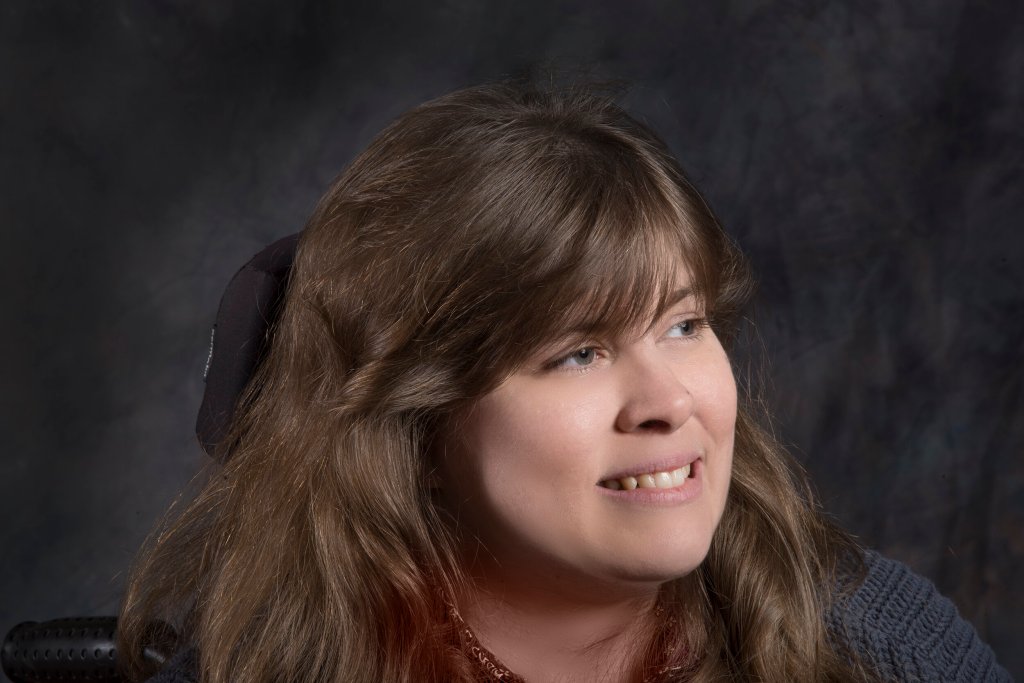
The girl, now a woman, is Jennifer Keelan Chaffins. Jennifer was born prematurely in Grand Rapids, MI. When she was two, doctors diagnosed her with Cerebral Palsy. It was around then that she says she first began to realize that she had a disability. One day she and her friends were playing Duck, Duck, Goose and they wanted to go outside and continue the game. As they went outside, she tried following them, but says she couldn’t get her body to cooperate and couldn’t stand up. Throughout her young life, Jennifer’s family prescribed to the social model as opposed to the medical model of disability, believing it wasn’t a problem that Jennifer had a disability; the attitudes and inaccessibility imposed by society were the problem. “Jennifer didn’t have a problem, society did,” as her mother Cynthia says. “Walking wasn’t a priority, but her intelligence and abilities were.” Jennifer attended her first protest at age six while living in Arizona. Other notable attendees at the protest included Diane Coleman, President and CEO of Not Dead Yet, (https://notdeadyet.org) an organization that opposes assisted suicide, and Jennifer’s relative Tom Olin, who was the National American Disabled for Attendant Programs Today (ADAPT) photographer, and coincidentally, was the person who took the famous photo of Jennifer climbing the Capitol steps. Jennifer’s attendance at this protest would spur her life of advocacy. The protest was focused on getting lifts on public transportation buses. Jennifer was so inspired by the protests and advocacy of the group, that she went on to protest with them in San Francisco where she met towering figures of the disability rights movement such as Judith Heumann (Crip Camp) and Justin Dart Jr., the Father of the Americans with Disabilities Act (ADA) who was present with President Bush at its signing. (https://cdrnys. org/blog/advocacy/a-short-history-of-justindart-jr-father-of-the-ada/ )
A CHILD OF THE MOVEMENT GROWS UP
What happens when a child of the movement grows up? Like adults with and without disabilities, Jennifer’s emergence into adulthood included the deep desire to live independently and achieve a higher education and gainful employment.
Jennifer, at various points in her life, faced many barriers to affordable, accessible housing, a common problem faced by many people with disabilities. Aside from the challenge of finding accessible housing that met her needs and desires, she repeatedly witnessed others with disabilities who were being denied housing vouchers from the Department of Housing and Urban Development (HUD) or were forced out on to the streets and into institutions. People with disabilities were being consistently denied the opportunity to live within the community at a place of their choice. Jennifer also saw people with disabilities being forced to prove they were mentally stable enough to live in the community, as their disability was often used against them because housing authorities had the right to question their ability to live in the community. Jennifer explains that this is common practice in HUD programs, and the housing authority and management have the right to “test” people and determine where they would be better suited to live. This kind of attitude by the housing authority displays ableism in and of itself. The housing authority would ultimately reject Jennifer because it couldn’t accommodate her accessibility needs. Jennifer says there were even times she suspected she had her rent raised after asking for accommodations. Jennifer continued to fight for accommodations in housing and employment and obtained two college degrees, all while having to continually prove her disability and need for accommodations despite being obviously physically and permanently disabled and using complex rehab technology, such as a Permobil F5 VS Corpus stander chair for mobility, that can only be obtained by a physician’s recommendation and insurance approval. “Let’s just say you can’t just buy this chair at Walmart,” she says of her chair. “It would seem to me that housing authorities have been given too much leeway to not comply with ADA and other disability rights laws when it comes to accommodations, in particular for service animals, and HUD doesn’t seem to care either,” Jennifer says. In reflecting on the passage of the ADA, Jennifer is aware of the importance of its significance in the disability rights movement, as well as her role in it. “The ADA is our Emancipation Proclamation,” Jennifer has stated. “We should come together to use our unified voice to demand our rights be recognized.” But for one of the most important pieces of civil rights legislation ever passed, Jennifer knows the law has its limits, specifically when it comes to the access the law is meant to ensure. “We’ve gone backwards. Buildings still aren’t ADA compliant,” she observes, adding “but the ADA is not just about the black and white law.” Jennifer believes from her personal experiences that the civil rights divisions and agencies that are paid to enforce, protect, and adhere to the ADA have failed to do their job. Another purpose of the ADA was to teach and empower people with disabilities to “use their voice” and have a greater understanding of the ADA. “The ADA is also about teaching personal empowerment and I am hoping to achieve that through my children’s book All the Way to the Top,” Jennifer said (available at https://jkclegacy.com). “The book is not only a nod to the 30th anniversary of the ADA, but a way to teach the next generation about the ADA’s importance and the history and what it took to make it happen,” Jennifer says. COVID
One of Jennifer’s current concerns is the fear that if she were to be injured or become ill and an ambulance is called, she’ll automatically be sent to a nursing home which may include COVID patients. Jennifer is aware of the challenges patients with disabilities potentially face when they enter a hospital and could be exposed to COVID on top of any other conditions they may have. “Now is the time to say we’re not going to take it anymore,” she says. Jennifer explains that the entire disabilities rights community nationwide is very concerned about these issues and is constantly monitoring and contacting members of Congress, state representatives and Health and Human Service agencies who control Medicaid to stop discriminatory policies that are being created. In her opinion, COVID 19 has made it vividly clear that the lives of people with disabilities are not considered as important as those without disabilities.
She stresses the importance of people with disabilities having a plan when they go to the hospital that would make doctors aware of the patient’s desire and right to receive lifesaving medical treatment. It is an ADA violation to deny treatment because of a person’s disability, yet some hospitals are ignoring this. Having just celebrated the 30th anniversary of the passage of the ADA, it’s so important to remember the figures who influenced the passage of the law, and Jennifer Keelan Chaffins is one of them. Her story shows many things, such as that you can make a profound difference in the world at any age. The advocacy skills she learned as a child from major figures of the disability rights movement served her well as she went on to fight for things such as affordable and accessible housing, a need for which is still felt by millions of people with disabilities across the nation. She was a child of the movement whose journey up the Capitol steps showed the world why passage of the law was so necessary. You can visit Jennifer’s website at https:// jkclegacy.com/
 Imagine the World as One Magazine